


Subtotal $0.00
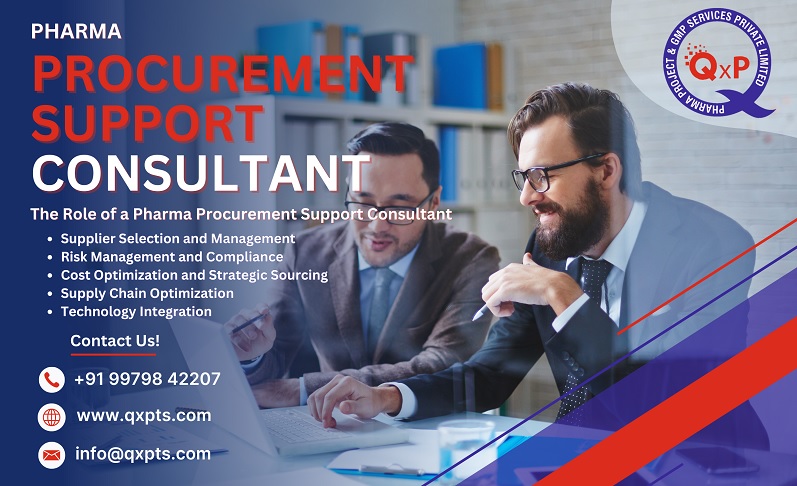
Pharmaceutical procurement consulting helps drug manufacturers choose, qualify and manage the suppliers behind every batch and every project: APIs and excipients, packaging materials, process equipment, utilities and cleanroom materials. QxP Pharma Project & GMP Services, based in Ahmedabad, supports pharma companies across India with vendor identification and qualification, sourcing strategy, GMP-compliant procurement documentation and procurement planning for greenfield and brownfield turnkey projects.
This guide explains what the work involves, how GMP-led procurement differs from general purchasing, and how to choose a procurement consulting partner.
What Is Pharmaceutical Procurement Consulting?
Pharmaceutical procurement consulting is a specialist advisory service that helps pharmaceutical, biopharma, medical device and nutraceutical companies buy materials, equipment and services in a way that is cost-effective, on time and compliant with GMP. A pharma procurement consultant designs the sourcing strategy, finds and qualifies suppliers, supports negotiation and builds the documentation that regulators expect to see.
The scope usually covers:
- Active pharmaceutical ingredients (APIs) and excipients
- Primary and secondary packaging materials
- Process and utility equipment (HVAC, purified water, compressed air, clean steam)
- Cleanroom partitions, epoxy and PU flooring, electrical and mechanical materials
- Contract manufacturers (CMOs) and service providers
What does a pharma procurement consultant do?
A consultant acts as an extension of your project or supply chain team. In practice that means defining requirements, building a vendor long-list, qualifying suppliers through document review and audit, comparing bids on a like-for-like basis, following up purchase orders and handing over a complete documentation package. The aim is simple: the right material, from a qualified source, at the right total cost, with a paper trail that stands up to inspection.
How is it different from general procurement consulting?
In most industries, a cheaper supplier with acceptable quality is a good outcome. In pharma, a supplier who is not qualified can put a batch, a product licence or an inspection at risk. The table below shows the difference.
| Area | General procurement | Pharmaceutical procurement |
|---|---|---|
| Supplier selection | Price, delivery and reputation | Qualification first: licence, GMP status, audit history, quality agreement |
| Documentation | Purchase order and invoice | Specifications, certificates of analysis, traceability records, audit reports |
| Changes at the supplier | Usually communicated informally | Controlled through change-control and quality agreements |
| Regulator interest | Rarely examined | Reviewed during GMP inspections and regulatory audits |
| Cost of a wrong choice | Rework or replacement | Batch rejection, recall, delayed approval or a compliance observation |
Why Pharma Procurement Is Different: GMP and Regulatory Requirements
Procurement is part of the pharmaceutical quality system, not a back-office activity. Regulatory frameworks expect manufacturers to know their suppliers and to control the materials they receive. The main reference points are:
- ICH Q7 (GMP for active pharmaceutical ingredients), which covers materials management and supplier qualification for API manufacturers.
- ICH Q9 (quality risk management), used to decide how deeply each supplier and material needs to be assessed.
- ICH Q10 (pharmaceutical quality system), which makes the manufacturer responsible for the quality of outsourced activities and purchased materials.
- EU GMP (EudraLex Volume 4) and US FDA 21 CFR Parts 210 and 211, which companies exporting to Europe and the United States must meet.
- WHO GMP and the revised Schedule M under India’s Drugs Rules, which set the baseline for Indian manufacturers.
You can read the primary documents at the ICH quality guidelines, the European Commission EudraLex Volume 4 page, the 21 CFR Part 211 text on eCFR and the CDSCO .
For procurement, these requirements translate into five practical controls:
- Qualify the supplier before the first purchase.
- Audit critical suppliers, or review a credible third-party audit.
- Sign quality agreements that include change notification.
- Buy against an approved specification, never against a price list alone.
- Keep traceability from supplier batch to your finished product.
QxP supports these controls through its vendor and third-party GMP audits, contract manufacturing audits and GMP compliance consulting.
Pharmaceutical Procurement Strategy: A Practical Framework
A good pharmaceutical procurement strategy is a set of decisions made before any request for quotation goes out. Four decisions matter most.
1. Segment spend by category and regulatory risk
Not every purchase deserves the same effort. Group your spend into categories and rate each one by its impact on product quality and patient safety. An API or a primary packaging component needs deep qualification. A general maintenance item does not. This is the quality risk management logic of ICH Q9 applied to buying.
| Category | What must be qualified | Typical failure mode |
|---|---|---|
| APIs and excipients | Manufacturer, site GMP status, specification, DMF or CEP where applicable, change control | Unannounced process or site change at the supplier |
| Packaging materials | Material specification, printing and artwork control, supplier quality system | Artwork errors, particulate or extractables issues |
| Process equipment | User requirement specification, design documents, FAT and SAT, qualification support | Equipment that cannot be qualified against the URS |
| Utilities and HVAC | Design basis, materials of construction, commissioning documents | Capacity shortfall, poor cleanroom performance |
| Services and contract manufacturers | Quality agreement, audit outcome, scope of responsibility | Unclear ownership of deviations and batch release |
2. Use total cost of ownership, not unit price
The lowest quote often carries hidden costs: extra incoming testing, rejected lots, longer lead times, inventory buffers and audit effort. Compare suppliers on total cost of ownership, which includes price, quality cost, logistics, inventory carrying cost and the risk of supply disruption.
3. Manage supply risk: single-source and dual-source decisions
Relying on one supplier for a critical material creates a single point of failure. Qualifying a second source takes time and regulatory effort, particularly when the material is named in a registered dossier. Decide early which materials justify dual sourcing, and plan the qualification work before a shortage forces the decision.
4. Build vendor performance metrics
Track supplier performance after the contract is signed. The KPI table later in this guide shows which measures to use.
For a deeper look at this stage, see QxP’s strategic sourcing for pharma projects service.
Our Pharma Procurement Consulting Services
QxP Pharma Consultants provides procurement support for pharmaceutical manufacturers, CROs and project developers. Each service below is described by what we do and what you receive.
Vendor identification and qualification
What we do: identify suppliers of materials, APIs and machinery from our network, then evaluate them on quality, compliance, delivery timelines and pricing. This includes site audits and GMP compliance checks. What you receive: a qualified vendor list with supporting evidence and an audit or assessment record for each critical supplier. When you need it: before the first purchase order, and whenever you add a second source.
Sourcing strategy, RFQ and negotiation
What we do: analyse domestic and global markets, prepare the request for quotation against an agreed specification, run competitive bidding and support negotiation, with sourcing plans adjusted for risk. What you receive: a comparative bid analysis that shows total cost, not just price. When you need it: for new setups, expansions and any high-value purchase.
Procurement for turnkey, greenfield and brownfield projects
What we do: handle procurement from vendor selection to final material delivery, including equipment and utility procurement, procurement planning aligned with the project schedule, and support for installation and commissioning. What you receive: a procurement plan tied to project milestones and a controlled flow of long-lead items. When you need it: at the start of a project, because equipment lead times often decide the schedule. See our turnkey pharma projects, greenfield and plant modification services, and our project scheduling support.
GMP-compliant procurement documentation and SOPs
What we do: design and implement procurement SOPs, vendor audit reports, certificates, material specifications and traceability records, and support ERP integration and performance measurement. What you receive: an inspection-ready documentation set and trained procurement staff. When you need it: before a regulatory inspection or customer audit, or when you formalise a procurement function.
Read more on our main service page: pharma procurement support services.
How a Procurement Engagement Works
- Scoping and requirements. We agree what you need to buy, the specifications, the budget and the delivery dates.
- Vendor long-list. We shortlist domestic and international suppliers against your requirements.
- Qualification and audit. We review documents, assess GMP status and, for critical suppliers, audit the site.
- Bid evaluation. We compare technical and commercial offers on a total-cost basis and support negotiation.
- Purchase order and delivery follow-up. We track production, inspection and dispatch against the plan.
- Documentation handover. You receive the records that prove the material or equipment was sourced under control.
Vendor Qualification Checklist for Pharma Manufacturers
Use this checklist when assessing a new supplier of materials, APIs or equipment. It applies to most categories, though the depth should follow the risk.
| Check | What to look for |
|---|---|
| Manufacturing licence | Valid licence for the product or activity, issued by the competent authority |
| GMP or WHO-GMP status | Current certificate and recent inspection history |
| Audit history | Previous audit reports, observations and closure of corrective actions |
| Quality management system | Documented QMS, deviation handling and CAPA process |
| Change control | Written commitment to notify you of changes before they are implemented |
| Regulatory file (APIs) | DMF, CEP or equivalent where relevant to your registrations |
| Specifications and CoA | Agreed specification and batch-wise certificates of analysis |
| Capacity and lead time | Ability to meet your volume and delivery plan without stretching |
| Financial standing | Evidence the supplier can sustain supply over the contract period |
| References | Customers in comparable regulated markets |
| Traceability | Ability to trace batches from raw material to dispatch |
| Quality agreement | Signed agreement defining responsibilities on quality, change and complaints |
How to Choose a Pharma Procurement Consultant
Ask any prospective partner these questions:
- GMP depth: can they assess suppliers against GMP, not just negotiate prices?
- Vendor network: do they have access to qualified domestic and international suppliers?
- Project experience: have they supported projects similar to yours, such as turnkey, greenfield or brownfield work?
- Documentation capability: will you receive records that satisfy an inspector?
- India and export-market knowledge: do they understand both Indian requirements and the expectations of regulated export markets?
- Transparency: are deliverables, scope and fees explained clearly before the work starts?
KPIs to Measure Procurement Performance
| KPI | What it measures |
|---|---|
| On-time in-full (OTIF) delivery | Share of orders delivered on the agreed date and in the agreed quantity |
| Vendor audit outcomes | Number and severity of audit observations, and how quickly they are closed |
| Supplier-related deviations | Deviations or rejections traced to supplier material |
| Cost against baseline | Total cost compared with the agreed benchmark, not unit price alone |
| Procurement cycle time | Time from requirement to purchase order and from order to receipt |
| Supplier concentration | Share of critical materials that depend on a single source |
Procurement Support for Pharma Companies in India and Export Markets
QxP Pharma Consultants is based in Ahmedabad, Gujarat, and works with pharmaceutical companies across India. Our team coordinates with Indian and international vendors and supports facilities that supply regulated export markets such as Europe and the United States, where GMP expectations on supplier control are strict.
We serve these sectors:
- Formulations (oral, injectable and topical)
- Active pharmaceutical ingredients (APIs)
- Biopharmaceuticals
- Medical devices
- Herbal and Ayurvedic products
- Nutraceuticals
Procurement support is usually combined with other services such as qualification and validation, GMP gap assessment and project management. You can also review the companies we have worked with on our clients.
Why QxP Pharma Consultants?
- Procurement and engineering under one roof. Procurement is linked to design, turnkey execution, validation and GMP compliance, so purchasing decisions match the project plan.
- GMP-first supplier control. Vendor audits, quality agreements, specifications and change control are built into the procurement process.
- Local presence, global standards. We work from Ahmedabad and support projects across India using international GMP expectations.
- Transparent scope. Every engagement starts with agreed deliverables, so you know what you will receive.
Contact: D-471 (Fourth Floor), Sobocenter, Above Wholesale Market, Gala Gymkhana Road, South Bopal, Bopal, Ahmedabad, Gujarat 380058. Phone: +91 99798 42207 or +91 99798 94611. Email: info@qxpts.com.
Frequently Asked Questions
What is pharmaceutical procurement consulting?
- Pharmaceutical procurement consulting is an advisory service that helps drug manufacturers source materials, equipment and services in a cost-effective, timely and GMP-compliant way. It covers sourcing strategy, vendor qualification, bid evaluation, purchase follow-up and procurement documentation.
How is pharma procurement consulting different from general procurement consulting?
- General procurement focuses mainly on price and delivery. Pharma procurement adds supplier qualification, quality agreements, change control, traceability and audit readiness, because the materials affect product quality and are reviewed by regulators.
How do you qualify a pharmaceutical vendor or API supplier?
- Start with a document review of the manufacturing licence, GMP certificate, quality system and regulatory file such as a DMF or CEP. Add an audit or a credible third-party audit for critical suppliers, then sign a quality agreement and approve a specification before the first order.
When should procurement start in a new pharma plant project?
- Procurement should start during design and URS development, well before construction ends. Long-lead items such as HVAC units, process equipment and utilities often determine the project schedule, so early vendor selection protects the timeline.
What does a pharma procurement consultant deliver?
- Typical deliverables include a qualified vendor list, supplier audit or assessment reports, a comparative bid analysis, procurement SOPs, a procurement plan aligned with the project schedule and a documentation package for inspection.
How is a procurement consulting engagement priced?
- Pricing depends on scope, number of categories, supplier audits required, project size and duration. QxP defines scope and deliverables first and then shares a proposal, so you can compare it against the value of the work.
Can you support procurement for facilities that export to regulated markets?
- Yes. QxP aligns supplier qualification and documentation with GMP expectations such as EU GMP, US FDA requirements and WHO GMP, so that purchased materials and equipment support export compliance.
Which industries do you support?
- We support formulations (oral, injectable and topical), APIs, biopharmaceuticals, medical devices, herbal and Ayurvedic products and nutraceuticals.
