


Subtotal $0.00
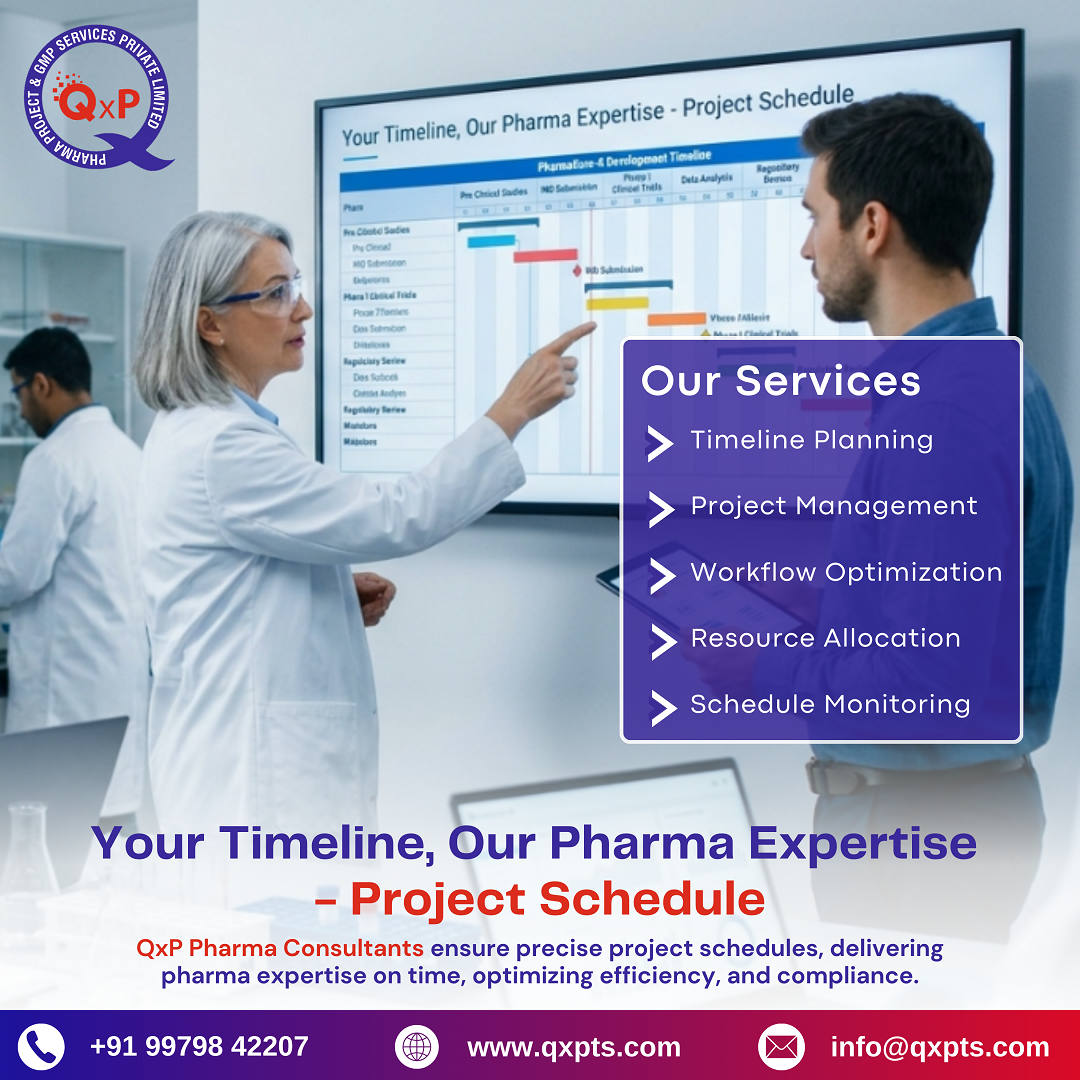
Smart Pharma Project Timeline Management with QxP GMP Specialists
Introduction: The Real Cost of an Unmanaged Pharma Project
Running a pharmaceutical project — whether it is a greenfield manufacturing plant in India, a GMP upgrade in Saudi Arabia, or a hospital facility expansion in the UAE — is not just a construction or engineering challenge. It is a highly regulated, timeline-sensitive undertaking where delays cost money, non-compliance risks licenses, and poor scheduling leads to failed audits.
Pharmaceutical companies operating across borders — from Southeast Asia to Europe, from Oman to Canada — face a shared reality: regulatory bodies do not wait, inspections do not reschedule easily, and gaps in project timelines can unravel months of preparation.
This is exactly why a professional Pharma Project Schedule Consultant is no longer optional. It is a strategic necessity.
At QXP Pharma Project Consultant & GMP Service PVT LTD, we work with pharmaceutical manufacturers, hospital administrators, procurement teams, and project directors across India and international markets — helping them manage project timelines with GMP compliance built into every milestone. To know more about our core offering, visit our dedicated Pharma Project Schedule service page.
The Growing Complexity of Pharma Project Management
Pharmaceutical projects are unlike any other industrial undertaking. They operate at the intersection of civil engineering, mechanical systems, regulatory compliance, quality assurance, and human safety — all simultaneously.
In India, a new API manufacturing unit must align with Schedule M requirements, pollution control board approvals, and factory act expectations — all while hitting commissioning deadlines tied to product launch calendars.
In the UAE or Qatar, contractors working on pharma facility builds are expected to meet both local regulatory standards and international GMP benchmarks set by agencies such as the USFDA, EMA, or TGA (Australia). The project schedule must account for all of these in a structured, audit-ready manner.
In markets like the UK and Europe, the culture of documentation is deeply embedded. Every schedule change, every equipment procurement delay, every validation milestone must be recorded, justified, and traceable. A project that cannot show this trail is a project that will fail its pre-approval inspection.
The challenge is real, and it is growing.
To understand global pharmaceutical compliance standards and improve your SEO strategy with Ahrefs insights, visit official guidelines from U.S. Food and Drug Administration.
What Is a Pharma Project Schedule Consultant — In Practical Terms?
A Pharma Project Schedule Consultant is not simply a project manager with a Gantt chart. This role involves understanding how GMP regulations, facility design requirements, equipment qualification timelines, and regulatory submission deadlines interact with each other — and then building a project execution plan that addresses all of them.
In practical terms, this means:
- Mapping every project activity to its regulatory dependency
- Aligning civil, mechanical, and validation work streams so they do not conflict
- Building in buffer time for inspection readiness, not just construction completion
- Creating documentation frameworks that satisfy agencies in multiple countries simultaneously
For a pharma CEO managing expansion into markets like Afghanistan or Tajikistan — where regulatory pathways may be emerging and less defined — this expertise becomes even more critical. Local compliance must be mapped against WHO-GMP or PIC/S standards to ensure international credibility is not compromised. We have worked extensively in Central Asian markets, including pharma project schedule consulting in Uzbekistan, where emerging regulatory environments require careful international alignment.
For a hospital administrator in Oman overseeing a pharmacy or compounding unit, the project schedule must reflect both construction timelines and licensing prerequisites — because one cannot proceed without the other.
Common Risks When Pharma Project Schedules Are Poorly Managed
Across hundreds of pharmaceutical projects globally, certain failure patterns repeat themselves:
1. Regulatory Submission Misalignment A facility completes construction but is not ready for regulatory inspection because the documentation — SOPs, validation protocols, equipment qualification reports — was not developed in parallel. The launch is delayed by months.
2. Equipment Procurement Without Timeline Cushion Long-lead items such as HVAC systems, clean room panels, or purified water systems are ordered late, pushing validation and qualification schedules entirely off track.
3. Change Control Gaps Scope changes during execution — very common in pharma projects — are not formally documented. When the regulatory inspector reviews the project history, the discrepancies raise red flags.
4. Workforce and Contractor Coordination Failures In multi-country projects involving India-based engineering contractors working on sites in the USA or Canada, time zone, communication, and compliance standard gaps create execution errors that are expensive to resolve.
5. Pre-Qualification Activities Missed Activities like Factory Acceptance Testing (FAT), Site Acceptance Testing (SAT), and Installation Qualification (IQ) are not properly sequenced, leading to rework and failed inspections.
These are not hypothetical scenarios. They are the lived reality of pharma project management when schedule expertise is absent.
How Expert Pharma Project Scheduling Reduces These Risks?
When a qualified Pharma Project Schedule Consultant is engaged from the early stages of a project, the approach shifts from reactive to preventive.
- Milestone-Based Planning with Regulatory Logic Every key milestone — from site preparation to HVAC commissioning to validation completion — is mapped against its regulatory prerequisite. This ensures the project is not just physically complete but inspection-ready at the right time.
- Documentation in Real Time Rather than scrambling to prepare documentation before an audit, a well-scheduled project generates compliance documentation as a natural output of each phase. This is the standard expected in markets like the UK, Europe, and the USA — and increasingly required in the Middle East as well.
- Risk Register and Contingency Planning Professional project scheduling includes a living risk register — identifying potential delays (equipment lead times, regulatory feedback cycles, vendor qualification timelines) and building contingency paths so the overall project does not stall when one element shifts.
- Cross-Functional Coordination Pharma projects involve quality assurance, engineering, procurement, regulatory affairs, and operations teams. An experienced consultant acts as the integrating layer — ensuring that each function’s work feeds correctly into the master schedule.
For best practices in pharma project planning, explore this guide aligned with Yoast SEO recommendations and insights from International Society for Pharmaceutical Engineering.
Country-Specific Considerations That Affect Pharma Project Timelines
- India India’s pharmaceutical manufacturing sector is one of the most active in the world, with a large number of USFDA, EMA, and WHO-GMP approved facilities. However, domestic project timelines are often compressed due to market pressure. The gap between physical completion and regulatory readiness is a recurring issue, particularly for facilities targeting export markets. Our on-ground experience across Indian states — including pharma project scheduling in Himachal Pradesh and pharmaceutical project consulting in Gujarat — reflects how state-specific regulatory environments demand tailored scheduling strategies.
- Middle East (UAE, Saudi Arabia, Qatar, Oman) The GCC region is investing heavily in domestic pharmaceutical manufacturing as part of broader healthcare self-sufficiency strategies. Projects in this region must navigate local health authority requirements while meeting the international GMP standards that international partners demand. Contractor compliance, especially on large-scale builds, is a consistent challenge.
- USA and Canada USFDA expectations around project documentation — particularly for new facility approvals or significant modifications — are stringent. The project schedule itself is considered an audit artifact. In Canada, Health Canada follows a similarly rigorous approach. Pharma companies setting up or expanding in North America benefit greatly from consultants who understand the intersection of engineering timelines and regulatory filing strategies.
- Europe and UK Post-Brexit, the UK MHRA operates independently from the EMA, meaning projects targeting both markets may need dual compliance planning. European GMP inspections are thorough, and the inspection readiness timeline must be built into the project schedule from day one.
- Australia and Southeast Asia TGA in Australia and regulatory bodies across Southeast Asia (including BFAD in the Philippines, NPRA in Malaysia, and others) are increasingly aligning with PIC/S standards. Projects here benefit from a schedule framework that is globally structured but locally interpreted.
Worker Safety and On-Site Compliance During Pharma Projects
Large pharma facility projects involve significant civil and mechanical construction activity. Worker safety during this phase is a compliance obligation — not just an ethical one.
In international project environments, workforces are often multilingual. Teams must deliver safety briefings, hazard communication, and emergency procedures in formats that every worker can understand and act upon.
This is a practical challenge that experienced safety-oriented project managers solve through visual communication, structured toolbox talks, and site-specific safety plans.
For factory owners and industrial managers overseeing pharma construction projects in India, the UAE, or Southeast Asia, ensuring that contractor safety compliance is auditable — with signed records, training logs, and incident reporting systems — protects the project owner from regulatory and legal exposure.
Ready to streamline your pharma project timeline? Contact QxP Pharma Consultanttoday for expert GMP-compliant scheduling solutions.
The Role of Documentation and Audit Readiness
A well-managed pharma project leaves a complete, traceable record. Every decision, every design change, every equipment qualification, every contractor safety meeting — documented, timestamped, and organized.
This documentation serves multiple purposes:
- Regulatory inspections: USFDA, EMA, WHO-GMP, and national health authorities all review project history as part of facility approval
- Insurance compliance: Insurers evaluating pharmaceutical manufacturing facilities look at project records to assess risk
- Client audits: Clients frequently audit contract manufacturers and CMOs before awarding business.
A Pharma Project Schedule Consultant who understands this documentation culture — and builds it into the project timeline from the beginning — delivers a fundamentally different outcome than one who manages only physical construction progress.
Long-Term Business Value of Professional Pharma Project Management
The return on investing in expert pharma project scheduling is not theoretical:
- Facilities that achieve regulatory approval on schedule begin generating revenue months ahead of those that experience inspection failures
- Well-documented projects enable teams to expand, modify, or license them more easily because they already have an established baseline.
- International credibility — the ability to supply markets in the USA, Europe, or Australia — is built on a foundation of compliant, well-documented facility history
For pharma company CEOs and CFOs evaluating the cost of expert scheduling support against the cost of a failed inspection or a delayed product launch, the calculation is straightforward.
What to Look for in a Pharma Project Schedule Partner?
Before engaging any consultant for pharma project scheduling, consider:
- International experience: Have they managed projects across multiple regulatory jurisdictions?
- GMP technical knowledge: Do they understand validation, qualification, and documentation requirements — not just construction management?
- Local compliance awareness: Can they navigate India’s factory approvals, GCC health authority requirements, and USFDA filing timelines within a single project framework?
- Practical on-site capability: Do they have teams who can work on the ground, not just in advisory capacity?
Conclusion: Schedule Is Strategy in Pharma
In pharmaceutical projects, a schedule is not just a timeline. It is a strategic document that determines regulatory outcomes, financial performance, and market access.
Whether you are a hospital administrator in Oman planning a compounding pharmacy, a factory owner in India preparing for a WHO-GMP audit, or a project director managing a facility build for the US market — the quality of your project schedule determines your success.
QXP Pharma Project Consultant & GMP Service PVT LTD brings together GMP compliance expertise, international project management experience, and on-the-ground execution capability to help pharmaceutical and healthcare organizations deliver projects that are not just built — but inspection-ready, compliant, and sustainable.
If your next pharma project deserves expert schedule management, we are ready to be part of your team.
Let’s make your project inspection-ready—get in touch with QxP Pharma Project Consultant & GMP Services now for tailored guidance.
Key Takeaways
- Worker Safety: On-site safety compliance during pharma construction is a regulatory and ethical obligation — in every country
- Legal & International Compliance: Project documentation is an audit artifact — treat it that way from day one
- Risk Reduction: Early-stage schedule planning prevents inspection failures, regulatory delays, and cost overruns
- Global Operational Confidence: A properly scheduled pharma project meets compliance expectations in India, the Middle East, Europe, North America, and beyond
- Expertise Matters: Pharma project scheduling requires GMP knowledge, not just project management experience
Frequently Asked Questions (FAQs)
Q1: What is a Pharma Project Schedule Consultant and why does my company need one?
- A Pharma Project Schedule Consultant integrates GMP compliance milestones, regulatory filing timelines, equipment qualification phases, and construction activities into a unified project plan. Companies that engage this expertise experience significantly fewer inspection failures and project overruns.
Q2: How does pharma project scheduling differ from regular construction project management?
- Standard construction management focuses on physical milestones. Pharma project scheduling adds a regulatory layer and ensures teams complete documentation, validation, and inspection readiness in sync with the physical build.
Q3: We are expanding our facility to target the US and European markets. How does project scheduling support this?
- USFDA and EMA both review facility history as part of approval processes. A well-managed project generates the documentation trail that satisfies these agencies, making the approval process smoother and faster.
Q4: Can a single consultant manage compliance across India, the Middle East, and international markets?
- Yes — experienced consultants like the team at QXP Pharma Project Consultant & GMP Service PVT LTD work across multiple regulatory jurisdictions, adapting the project framework to local requirements while maintaining international GMP standards.
Q5: What industries and project types does QXP serve?
- QXP Pharma Project Consultant & GMP Service PVT LTD serves pharmaceutical manufacturers, hospital facilities, API plants, and related healthcare infrastructure projects across India and international markets.
#PharmaProjectSchedule #GMPCompliance #PharmaConsultant #QXPPharma #PharmaceuticalManufacturing #GoodManufacturingPractice #PharmaIndia #PharmaUAE #PharmaSaudiArabia #PharmaCompliance #ProjectManagement #RegulatoryAffairs #PharmaCEO #HospitalCompliance #PharmaMiddleEast #GMPAudit #PharmaProjectManagement #IndustrialSafety #PharmaceuticalIndustry #QXPPharmaConsultant
