


Subtotal $0.00
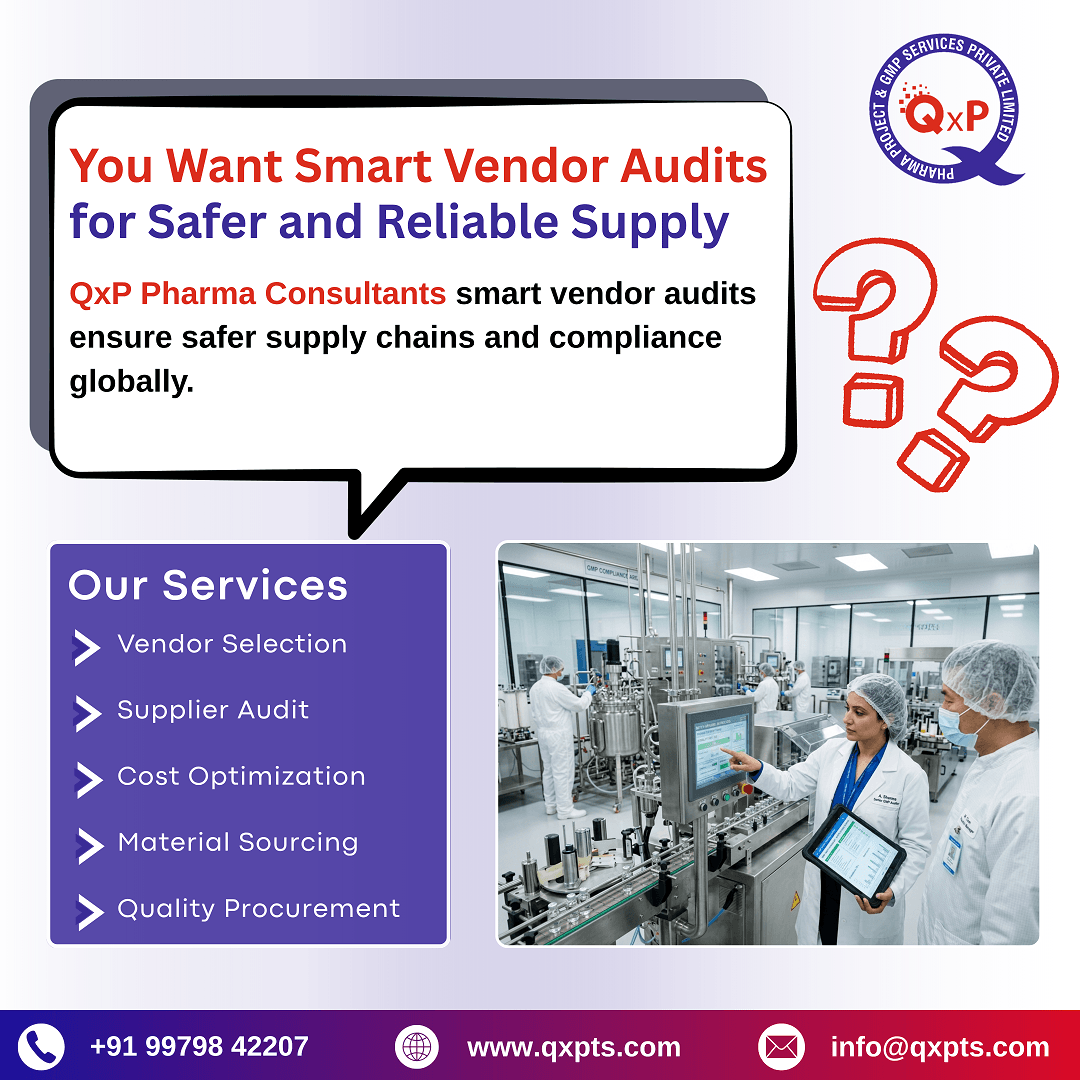
In today’s increasingly complex pharmaceutical landscape, the quality of your supply chain is only as strong as your weakest vendor. For pharma manufacturers across India — from the Gujarat API belt to the Maharashtra formulation hub — one unqualified raw material supplier can trigger a regulatory catastrophe: batch failures, CDSCO show-cause notices, WHO inspection failures, or worse, market recalls. Smart vendor audits build trusted pharma supply chains by identifying compliance gaps before regulators do, qualifying suppliers against Schedule M, WHO TRS 986, and ICH Q7 standards, and giving your quality team documented, defensible evidence of due diligence. QXP Pharma Project Consultant & GMP Service Pvt. Ltd. works with pharma companies across pan-India to design and execute vendor audit programs that are regulatory-grade, operationally practical, and built for audit-readiness from day one.
How Smart Vendor Audits Build Trusted Pharma Supply Chains in the Indian Regulatory Context?
The question most pharma manufacturers in India ask is: “We have a vendor approval process — isn’t that enough?” The honest answer is no — not in today’s CDSCO-enforced, WHO-aligned compliance environment. A vendor approval form without a physical or remote GMP audit, without review of the supplier’s WHO GMP certification India status, and without periodic re-qualification is a documentation gap waiting to be flagged. Under the revised Schedule M notified in 2023, Indian pharmaceutical manufacturers are now explicitly required to qualify their starting material suppliers, conduct supplier audits, and maintain documented quality agreements. This applies equally to API producers in Ahmedabad, tablet manufacturers in Pune, and sterile injectable units in Hyderabad. Smart vendor audits build trusted pharma supply chains by converting this regulatory requirement into a systematic, repeatable process that protects your product quality and your manufacturing license simultaneously.
What a GMP-Compliant Vendor Audit Actually Covers — And Why Most Companies Get It Wrong?
Most pharma companies in India treat vendor audits as a checkbox — a site visit, a questionnaire, a signature, and a file. That approach fails during WHO prequalification inspections, EU GMP assessments, or USFDA supplier qualification reviews. A genuine smart vendor audit covers seven critical domains: quality management systems, personnel qualifications, facility and equipment qualification, raw material controls, in-process and finished product testing, change control and deviation management, and documentation integrity. GMP compliance India requirements under Schedule M demand that each of these domains is assessed, documented, and linked to a written supplier quality agreement. The pharma regulatory consultants at QXP Pharma Project Consultant & GMP Service Pvt. Ltd. have conducted vendor audits for API manufacturers in Gujarat, bulk drug producers in Hyderabad’s Genome Valley corridor, and formulation units in Nagpur and Jaipur — bringing a structured audit checklist aligned to WHO TRS 957, ICH Q7, and CDSCO current GMP expectations.
How to Hire the Right Smart Vendor Audit Consultant for Your Pharma Company in India?
If you are a pharma startup founder in Mumbai, a plant compliance manager in Surat, or a regulatory affairs head in Pune trying to qualify a new API vendor, the process of finding competent audit support can itself feel overwhelming. The right hire smart vendor audit consultant for pharma company in India decision comes down to three criteria: regulatory depth (does the consultant understand Schedule M, WHO TRS 986, ICH Q7, and 21 CFR Part 211 simultaneously?), geographic reach (can they physically audit vendors in Gujarat, Maharashtra, Rajasthan, and beyond?), and documentation quality (can they produce audit reports that survive WHO inspector review?). QXP Pharma Project Consultant & GMP Service Pvt. Ltd. offers end-to-end vendor audit and third-party audit services — from pre-audit gap assessment to corrective action plan (CAPA) follow-up — with a team experienced in pharma regulatory services India across both domestic compliance and export market requirements. You can explore their structured audit approach at their dedicated vendor audit services page.
GMP Audit Preparation for Pharma Vendors Across Gujarat, Maharashtra, and Pan-India Pharma Hubs
The GMP audit preparation consultant in Gujarat and Maharashtra market is growing rapidly because regulatory enforcement is intensifying. CDSCO’s increased inspection frequency post-2022, combined with WHO’s stricter prequalification supplier audit requirements, means pharma companies can no longer afford to have unqualified vendors in their supply chain. In Ahmedabad and Surat, where the Gujarat API belt houses hundreds of active pharmaceutical ingredient manufacturers, supplier qualification backlogs are common — especially for companies expanding into regulated markets like the EU, US, or WHO-tendered markets. In Maharashtra’s formulation cluster — spanning Pune, Nagpur, and Mumbai — contract manufacturers face increasing pressure from multinational clients demanding third-party vendor audit reports. Smart vendor audits build trusted pharma supply chains by giving companies in these geographies a structured, time-bound audit program that clears vendor backlogs, documents compliance status, and prepares both the auditee and the auditing company for regulatory scrutiny. QXP Pharma Project Consultant & GMP Service Pvt. Ltd. delivers this service across all major pharma hub cities in India, with domain expertise in audit and compliance consulting tailored to each geography’s specific regulatory profile.
Building Long-Term Supply Chain Trust Through Periodic Vendor Re-Qualification and CAPA Management
A single vendor audit is not enough. Drug manufacturing compliance under Schedule M, WHO guidelines, and ICH Q10 requires periodic re-qualification — typically annual for critical suppliers and biennial for secondary suppliers — along with robust CAPA tracking when audit findings are raised. The real value of smart vendor audits lies not just in the initial qualification but in the ongoing compliance relationship they establish. When a supplier receives a structured audit report with prioritized observations — critical, major, and minor — and a tracked CAPA plan, they understand exactly what must change and by when. This is how pharma regulatory consultants convert a one-time audit into a living supplier quality management system. QXP Pharma Project Consultant & GMP Service Pvt. Ltd. supports clients with full CAPA tracking, follow-up audits, and supplier development programs, helping pharma manufacturers across India — from Jaipur’s emerging pharma zone to Hyderabad’s bulk drug corridor — build supply chains that are not just compliant today but audit-ready tomorrow. For a deeper understanding of qualification and validation standards applied in regulated environments, see how similar compliance frameworks are applied in international pharma consulting contexts.
The regulatory landscape for pharma supply chain compliance in India is only going to tighten. The revised Schedule M, CDSCO’s risk-based inspection model, and the growing demand from regulated market buyers for supplier audit documentation are converging into a single message: your vendor qualification program must be as rigorous as your own GMP system. Companies that invest in smart vendor audits now — building documented, defensible, and periodically re-validated supplier qualification systems — will be the companies that scale into export markets, survive regulatory inspections, and attract multinational partnerships. Those that don’t will face the consequences in the form of import alerts, license suspensions, or supply chain disruptions at the worst possible time. To get started or discuss your vendor audit requirements, contact QXP Pharma Project Consultant & GMP Service Pvt. Ltd. directly — and begin building the supply chain trust your pharma business depends on. For reference on international GMP audit standards applicable to your vendor program, the WHO Good Manufacturing Practices guidelines and ICH Q7 Active Pharmaceutical Ingredients guideline provide the foundational regulatory benchmarks your audit checklist should be built upon.
Frequently Asked Questions
1. What is a smart vendor audit and why is it important for pharma supply chains in India?
- A smart vendor audit is a structured, GMP-compliant assessment of a raw material or API supplier’s quality systems, documentation, and manufacturing practices against benchmarks like Schedule M, WHO TRS 986, and ICH Q7. For pharma manufacturers in India, it is important because the revised Schedule M (2023) now mandates documented supplier qualification. Without it, your manufacturing license, CDSCO inspection outcomes, and regulated market access are all at risk.
2. How does QXP Pharma Project Consultant & GMP Service Pvt. Ltd. conduct vendor audits for pharma companies?
- QXP Pharma Project Consultant & GMP Service Pvt. Ltd. conducts vendor audits using a structured checklist aligned to Schedule M, WHO TRS 957, ICH Q7, and 21 CFR Part 211. The process includes pre-audit gap analysis, on-site or remote audit execution, a prioritized audit report with critical and major findings, and a tracked CAPA plan. Services are delivered across Gujarat, Maharashtra, Rajasthan, Hyderabad, and all major pharma hub cities in India.
3. Kya vendor audit sirf badi pharma companies ke liye hota hai, ya chhoti units ke liye bhi zaroori hai?
- Nahi — vendor audit sirf badi companies ke liye nahi hota. India mein har pharma manufacturer ko, chahe woh Gujarat ki API unit ho ya Maharashtra ki chhoti formulation company, Schedule M ke under supplier qualification zaroori hai. CDSCO inspections mein chhoti units bhi flag hoti hain agar unka vendor qualification program documented nahi hai. GMP compliance sabke liye equally applicable hai, Yaha Contact kare.
4. GMP audit preparation consultant Gujarat Maharashtra mein kaise dhundhe?
- GMP audit preparation consultant in Gujarat and Maharashtra dhundhne ke liye, ensure karein ki consultant ko Schedule M, WHO GMP certification India process, aur CDSCO norms ki deep knowledge ho. QXP Pharma Project Consultant & GMP Service Pvt. Ltd. jaise experienced consultants physical audits Ahmedabad, Surat, Pune, Nagpur mein conduct karte hain, aur unka track record regulated market requirements ke saath aligned hota hai.
5. How long does a vendor audit and CAPA closure process typically take for a pharma supplier in India?
- For a typical API or excipient supplier in India, the initial vendor audit takes one to two days on-site, followed by a detailed audit report within five to seven working days. CAPA submission by the supplier is expected within 30 days for major findings and 60 days for systemic observations. Re-audit or desktop review for CAPA closure follows within 30 days of CAPA submission. Timelines align with Schedule M and WHO GMP supplier qualification expectations.
6. Hamari pharma company Jaipur mein hai — kya vendor audit services wahan bhi milti hain?
- Haan — smart vendor audits aur pharma regulatory consulting services Jaipur, Rajasthan mein bhi available hain. QXP Pharma Project Consultant & GMP Service Pvt. Ltd. pan-India services deliver karta hai, including Rajasthan ke emerging pharma zones. Chahe aapki company ka vendor Gujarat mein ho ya Hyderabad mein, structured vendor qualification aur GMP audit preparation remotely ya on-site dono tarike se ki ja sakti hai.
7. What regulations govern vendor qualification requirements for Indian pharma manufacturers exporting to regulated markets?
- Indian pharma manufacturers exporting to EU, US, or WHO-tendered markets must comply with multiple overlapping frameworks: Schedule M (revised 2023) for domestic GMP compliance India, WHO TRS 986 for prequalification supplier audits, ICH Q7 for API supply chain qualification, and 21 CFR Parts 210–211 for USFDA-regulated supply. EU GMP Annex 8 also applies for starting material qualification. Each framework requires documented audit reports, signed quality agreements, and periodic re-qualification — all areas covered under drug manufacturing compliance and pharma regulatory services India.
