


Subtotal $0.00
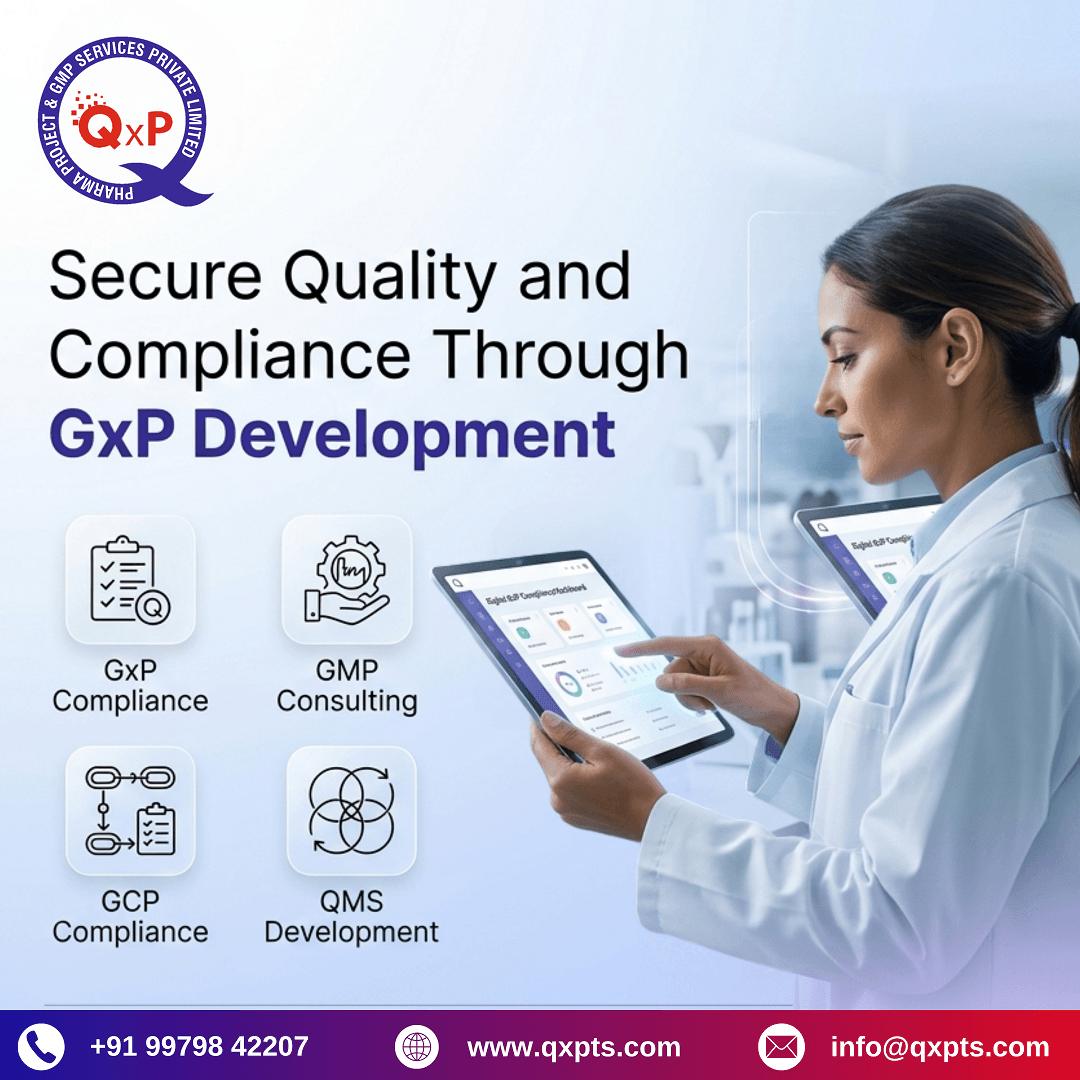
For any pharma manufacturer, API producer, or formulation unit operating in India today, the ability to secure quality and compliance through GxP development is no longer a regulatory checkbox — it is a business survival strategy. Regulatory agencies including CDSCO, WHO, USFDA, and EU GMP authorities are tightening inspection standards, and Indian pharma companies across Gujarat, Maharashtra, Rajasthan, and Hyderabad are increasingly facing warning letters, import alerts, and facility shutdowns due to preventable GxP gaps. QXP Pharma Project Consultant & GMP Service Pvt. Ltd. helps pharma companies build quality systems that withstand scrutiny — from plant design to documentation to audit readiness — ensuring your facility is inspection-ready before regulators arrive.
Why Indian Pharma Companies Must Secure Quality and Compliance Through GxP Development?
The phrase “GxP” covers the full spectrum of Good Practices that govern pharmaceutical manufacturing, laboratory operations, clinical trials, and distribution — including GMP (Good Manufacturing Practice), GLP (Good Laboratory Practice), GDP (Good Distribution Practice), and GCP (Good Clinical Practice). In India, Schedule M of the Drugs and Cosmetics Act lays down the statutory GMP requirements for licensed drug manufacturers, while WHO Technical Report Series (TRS) No. 986 and No. 1044 define international GMP benchmarks for WHO prequalification. For any drug company targeting domestic CDSCO approval, WHO GMP certification, or regulated export markets in the US or EU, failing to secure quality and compliance through GxP development means jeopardizing both licenses and revenues. Pharma clusters across Ahmedabad, Surat, Pune, and Nagpur are home to hundreds of manufacturers who face this compliance gap today.
The real risk is not just a failed audit. Regulatory non-compliance leads to product recalls, loss of export contracts, cancellation of manufacturing licenses, and reputational damage that takes years to recover. A pre-audit gap analysis conducted by an experienced GxP development consultant in India can identify critical deviations in facility design, documentation systems, equipment qualification, and personnel training — well before an official inspection triggers a 483 observation or a WHO critical finding. QXP Pharma Project Consultant & GMP Service Pvt. Ltd. has built its consulting practice specifically around identifying these gaps early and closing them systematically, helping clients across Gujarat, Maharashtra, Rajasthan, and Hyderabad convert compliance risk into competitive advantage.
How GxP Development Services in India Translate Into Real Regulatory Outcomes?
When a pharma startup founder or a plant compliance manager asks, “What does a GxP development consultant actually deliver?” — the answer must be specific. GxP development services in India delivered by QXP Pharma Project Consultant & GMP Service Pvt. Ltd. include: design and validation of Quality Management Systems (QMS) aligned with Schedule M (New), WHO TRS 986, ICH Q10, and 21 CFR Part 211; preparation of site master files and GMP dossiers; equipment and utility qualification (IQ/OQ/PQ); process validation protocols; Standard Operating Procedure (SOP) authoring and review; and personnel GxP training programs compliant with Schedule M requirements.
For manufacturers in Hyderabad’s bulk drug corridor or Mumbai’s formulation sector, regulatory compliance is increasingly linked to export market access. WHO GMP certification, required for pharma exports to over 140 countries, demands documented evidence of GxP compliance across all manufacturing operations. Pharma GxP development consultants in Gujarat serving API belt manufacturers understand the specific documentation and facility challenges unique to API production environments — from solvent handling compliance to environmental monitoring systems. QXP Pharma Project Consultant & GMP Service Pvt. Ltd. delivers end-to-end GMP documentation support and qualification services tailored to each facility’s regulatory pathway, whether that is CDSCO, WHO, USFDA, or EU GMP.
Hire a GxP Development Consultant for Your Pharma Company in India — What the Engagement Looks Like
If you are considering how to hire a GxP development consultant for your pharma company in India, understanding the engagement structure helps set the right expectations. Every compliance project at QXP Pharma Project Consultant & GMP Service Pvt. Ltd. begins with a thorough GxP gap assessment — a structured evaluation of your current quality systems against the applicable regulatory standard, whether Schedule M, WHO TRS, EU GMP Annex 1, or USFDA 21 CFR Part 211. The gap report identifies critical, major, and minor deviations and maps a corrective action plan with timelines linked to your inspection or certification target date.
Following the gap assessment, the consulting team moves into system-building — developing or revising your QMS infrastructure, including change control, deviation management, CAPA systems, batch record review, internal audit programs, and annual product quality reviews. For GMP audit preparation consultant services in Gujarat and Maharashtra, this phase also includes mock audits that simulate the actual inspection experience, covering both documentation review and plant walkthrough scenarios. For manufacturers in Jaipur, Pune, or Nagpur targeting WHO GMP certification, the timeline from gap assessment to certification-ready status typically runs between four to twelve months, depending on the facility’s baseline compliance level. Explore GxP total training and pharmaceutical consultant programs to understand how personnel training integrates into the compliance roadmap.
GMP Compliance India — Schedule M, WHO, and USFDA Standards Your Facility Must Meet
GMP compliance in India is governed by multiple overlapping regulatory frameworks depending on your product category, manufacturing site, and target market. For domestic CDSCO licensing, the Drugs and Cosmetics Act Schedule M (as amended) sets out facility, equipment, documentation, and quality system requirements. Schedule M (New), which aligns India’s domestic GMP standards closer to WHO and ICH norms, introduces stronger requirements for quality risk management, validation, and supplier qualification — areas where many small and mid-size pharma companies in Gujarat, Rajasthan, and Maharashtra currently have documented gaps.
For companies targeting regulated export markets, WHO TRS 1044 (2019) and ICH Q7 (for APIs) set the international compliance benchmark. USFDA inspection under 21 CFR Part 211 and EU GMP Chapter 1 both require robust data integrity frameworks, electronic records management, and computer system validation — compliance areas that require specialized expertise beyond standard domestic GMP consulting. International regulatory bodies have published detailed inspection expectations; the WHO GMP guidelines and ICH Q10 pharmaceutical quality system guidance are publicly referenced frameworks that QXP Pharma Project Consultant & GMP Service Pvt. Ltd. integrates directly into every client engagement, ensuring that the quality systems built today will satisfy both current CDSCO requirements and future international inspections.
Why Pan-India Pharma Companies Choose QXP Pharma Project Consultant & GMP Service Pvt. Ltd.?
The pharma regulatory services India landscape has many generalist consultants, but very few who combine deep GxP technical expertise with hands-on regulatory submission and inspection support across multiple agency standards simultaneously. QXP Pharma Project Consultant & GMP Service Pvt. Ltd. serves pharma manufacturers, API producers, formulation companies, contract manufacturers, and pharma startups across Ahmedabad, Surat, Pune, Mumbai, Hyderabad, Jaipur, Nagpur, and all major pan-India pharma manufacturing locations.
What differentiates this practice is the outcome-focused consulting model — clients engage not just for documentation writing but for regulatory milestone delivery: CDSCO license approval, WHO GMP certification, USFDA pre-inspection readiness, or EU GMP compliance. Every engagement is structured around a clear compliance timeline with measurable deliverables — so your plant head, regulatory affairs team, and senior management always know exactly where the facility stands against its certification target. For drug manufacturing compliance and pharma license consultant India requirements, explore the Nigeria GxP development case study to see how the same systematic GxP methodology delivers results across diverse regulatory environments. Whether you are a first-time exporter from Gujarat’s API belt or an established formulation company in Pune preparing for a WHO reinspection, securing quality and compliance through GxP development with QXP Pharma Project Consultant & GMP Service Pvt. Ltd. is the structured path to sustainable regulatory success.
Contact QXP Pharma Project Consultant & GMP Service Pvt. Ltd. today to schedule your GxP gap assessment and begin your compliance journey.
Frequently Asked Questions
1. What is GxP development and why is it important for pharma companies in India?
- GxP development refers to the structured implementation of Good Practices — including GMP, GLP, GDP, and GCP — across pharmaceutical manufacturing, laboratory, and distribution operations. For Indian pharma companies, it is the foundation for CDSCO licensing, WHO GMP certification, and regulated export market access. Without a documented GxP compliance system, your facility cannot pass regulatory inspections under Schedule M, WHO TRS 986, or 21 CFR Part 211, making it impossible to operate legally or compete in international markets.
2. Bhai, WHO GMP certification ke liye kya kya documents chahiye aur kitna time lagta hai India mein?
- WHO GMP certification ke liye aapko ek complete site master file, SOPs, validation protocols (IQ/OQ/PQ), batch records, QMS documentation, aur internal audit reports ready karni hoti hain — yeh sab Schedule M aur WHO TRS 1044 ke hisaab se hone chahiye. India mein ek average facility ke liye, gap assessment se lekar certification-ready status tak 4 se 12 mahine ka time lagta hai, depending on your baseline compliance. Gujarat aur Maharashtra ke manufacturers ke liye proper GxP development consultant hire karna is process ko significantly fast karta hai.
3. How do I hire a GxP development consultant for my pharma company in India, and what should I look for?
- When you hire a GxP development consultant for your pharma company in India, prioritize consultants who have hands-on experience with Schedule M (New), WHO TRS guidelines, CDSCO audit preparation, and 21 CFR compliance — not just documentation writers. The right consultant conducts a structured GxP gap assessment first, delivers a corrective action plan with timelines, and supports your team through mock audits and inspection response. QXP Pharma Project Consultant & GMP Service Pvt. Ltd. follows exactly this outcome-linked model for manufacturers across Gujarat, Maharashtra, Hyderabad, and pan-India.
4. GMP audit preparation consultant Gujarat Maharashtra mein kaisa kaam karta hai practically?
- GMP audit preparation mein consultant pehle aapki facility ka ek detailed walkthrough karta hai — equipment qualification, documentation review, SOP gaps, aur personnel training records sab check hote hain Schedule M ke against. Gujarat ke API manufacturers ke liye solvent handling aur environmental monitoring pe zyada focus hota hai, jabki Maharashtra ke formulation units mein batch record integrity aur CAPA systems critical hoti hain. Phir ek mock inspection hoti hai jo real CDSCO ya WHO audit jaisi feel karti hai — taaki aapki team inspection-ready ho jaye.
5. What is the difference between Schedule M and WHO GMP, and which standard applies to my pharma facility in India?
- Schedule M is the domestic GMP standard under India’s Drugs and Cosmetics Act, mandatory for all licensed drug manufacturers operating in India. WHO GMP — specifically WHO TRS 986 and TRS 1044 — is the international standard required for WHO prequalification and pharma exports to over 140 countries. Schedule M (New) has been aligned closer to WHO norms, but gaps still exist in areas like quality risk management and supplier qualification. Most pharma companies in Pune, Hyderabad, and Ahmedabad exporting to regulated markets must comply with both simultaneously.
6. Pharma startup founder hoon, GxP compliance se kahan se shuru karoon aur kitna budget rakhoon?
- Agar aap ek pharma startup hain India mein — Ahmedabad, Jaipur, ya Nagpur mein — toh GxP development ki shuruaat ek gap assessment se honi chahiye. Yeh assessment batata hai ki aapki facility Schedule M ya WHO GMP ke against kahan stand karti hai. Budget depend karta hai facility size, target market (domestic CDSCO vs. WHO GMP certification), aur existing system maturity pe. Ek structured consultant — jaise QXP Pharma Project Consultant & GMP Service Pvt. Ltd. — aapko ek phased compliance roadmap deta hai jisme costs predictable aur milestones clear hote hain.
7. What are the most common GxP compliance failures seen in Indian pharma audits today?
- The most frequent GxP compliance failures observed in Indian pharma audits — by CDSCO, WHO, and USFDA — include inadequate data integrity controls, missing or poorly written SOPs, incomplete equipment qualification (IQ/OQ/PQ) records, weak CAPA systems, insufficient personnel training documentation, and non-compliant batch manufacturing records. Facilities in Gujarat, Maharashtra, Rajasthan, and Hyderabad frequently receive observations in these same categories. A structured GxP development program addresses all of these systematically, reducing the risk of critical or major findings during actual regulatory inspections under Schedule M, WHO TRS, or 21 CFR Part 211.
