


Subtotal $0.00
Proper equipment qualification forms the backbone of any robust pharmaceutical manufacturing operation. When setting up a facility, verifying that every machine, from granulators to compression units, functions exactly as intended is not just a regulatory formality—it is a critical requirement for ensuring patient safety and product efficacy. For plant heads and founders planning a new facility, understanding the intricacies of Design Qualification (DQ), Installation Qualification (IQ), Operational Qualification (OQ), and Performance Qualification (PQ) is essential to avoiding costly delays during audits. By implementing a scientifically sound validation master plan early in the project lifecycle, manufacturers can establish a clear pathway to commercial production while minimizing the risk of non-compliance.
Why Choose QxP Pharma Project & GMP Services for Equipment qualification services?
The best approach to facility validation requires a deep understanding of both machinery and the strict regulatory frameworks governing our industry. Since 2018, QxP Pharma Project & GMP Services has been delivering practical, shop-floor-tested compliance strategies. Based in Ahmedabad at our D-471 Sobocenter headquarters, our ISO 9001:2015 aligned processes ensure that every protocol we write meets rigorous international standards.
Led by Mr. Pankaj Sojitra, a Lead Consultant with over 22 years of experience in facility setups, and Mr. Vijay Patel, a Senior GMP & Regulatory Expert with 18+ years of hands-on knowledge, our team has successfully delivered 300+ projects. We do not just hand over a set of generic templates; we provide customized, defensible qualification protocols that stand up to the toughest regulatory scrutiny. As active members of the Indian Pharmaceutical Association (IPA), we stay ahead of evolving guidelines to protect your investments.
Whether you are looking for a GMP consultant in Ahmedabad or need comprehensive support for a multi-line sterile facility in Hyderabad, our team integrates seamlessly with your engineering staff. Our deep roots in the Indian market mean we understand the practical realities of sourcing equipment locally versus importing it, and we tailor our qualification strategies to match your specific procurement choices without compromising on quality.
If you are exploring a broader facility upgrade, understanding how your core infrastructure aligns with these machines is vital. For insights into specialized infrastructure, you can review our expertise in clean room partition integration.
Our Equipment qualification services Consulting Capabilities
Yes, we provide end-to-end qualification documentation and execution support tailored to your specific manufacturing lines. Our capabilities cover the complete lifecycle of pharmaceutical equipment, starting from the user requirement specification (URS) phase through to final performance qualification. We specialize in creating protocols for solid oral dosage forms, liquid injectables, topical preparations, and API manufacturing units.
When you partner with us for Equipment qualification services, we bring a systematic, risk-based approach to your facility. Our experts evaluate the critical quality attributes (CQAs) of your products and the critical process parameters (CPPs) of your equipment to ensure that the qualification effort is focused where it matters most. This practical methodology reduces unnecessary testing while ensuring absolute compliance for critical components.
For manufacturers looking for a complete turnkey pharma plant setup near me, integrating equipment validation with facility engineering is a seamless process with our team. We often encounter clients in Pune and Indore who struggle with delayed timelines because their equipment qualification was treated as an afterthought rather than a core component of the project plan.
Get a Quote for Equipment qualification services
To see how equipment qualification fits into a broader engineering framework, you can explore our design and engineering execution capabilities.
Mini Success Story: Streamlining Solid Orals in Surat
Recently, a mid-sized solid orals manufacturer in Surat faced a critical roadblock when their newly procured blister packaging line failed initial operational tests due to incomplete vendor documentation. Our team stepped in, conducted a rapid gap analysis, reconstructed the missing factory acceptance test (FAT) data into robust IQ/OQ protocols, and executed the validation within 14 days, saving the client from a two-month commercial launch delay.
Navigating Regulatory Compliance & GMP Standards
Here’s how QxP Pharma Project & GMP Services ensures your equipment meets all statutory requirements. The regulatory landscape in India has matured significantly, and inspectors are no longer satisfied with tick-box compliance. Whether you are dealing with the local Gujarat FDA or preparing for a national CDSCO inspection, your qualification data must demonstrate data integrity, traceability, and scientific soundness.
Our team is deeply familiar with WHO GMP guidelines implementation and the latest revisions to Schedule M. We ensure that every piece of equipment is qualified strictly against the approved design intent and regulatory expectations. We act as your dedicated Schedule M compliance consultant, ensuring that your machinery’s calibration, material of construction (MOC) verification, and utility connections are documented with absolute precision.
When conducting a Turnkey Pharma Plant Setup, understanding the nuanced demands of different regulatory bodies is crucial. A facility in Mumbai preparing for an EU-GMP audit requires a different depth of qualification documentation compared to a domestic-focused unit in Jaipur aiming primarily for a CDSCO approval.
We also assist in verifying that your equipment operates within the specific environmental conditions required by your process. You can learn more about how we structure the foundational elements of manufacturing by looking at our process design approach.
As a trusted CDSCO approval consultant, we understand that inspectors heavily scrutinize the traceability between your URS, DQ, and final PQ results. We implement ALCOA+ principles across all qualification documents, ensuring your data is attributable, legible, contemporaneous, original, and accurate.
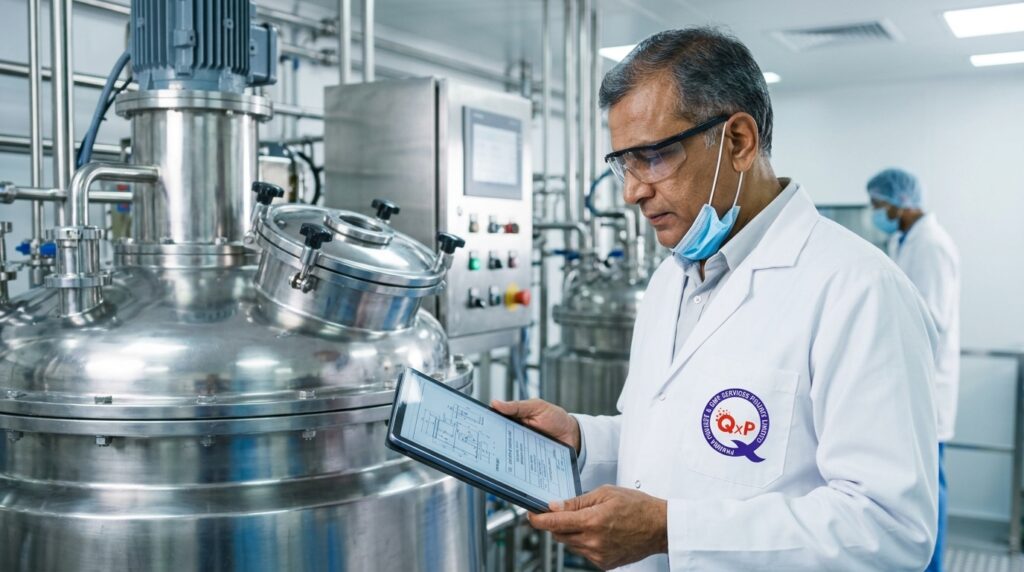
Local Consultants vs QxP Pharma Project & GMP Services
Many founders ask about the difference between hiring independent local contractors and partnering with an established consulting firm. When evaluating the overall pharma manufacturing unit setup cost India, facility owners sometimes opt for the cheapest documentation provider, only to face severe audit observations later due to copy-pasted protocols that do not reflect their actual machinery.
Below is a detailed comparison of how our structured approach differs from standard market practices.
| Evaluation Criteria | Standard Local Consultants | QxP Pharma Project & GMP Services |
|---|---|---|
| Protocol Customization | Uses generic, pre-filled templates that often miss machine-specific critical parameters. | Develops 100% custom protocols based on the specific URS, FAT, and manufacturer manuals. |
| Regulatory Expertise | Limited to basic domestic compliance; often unaware of recent Schedule M updates. | Deep expertise in CDSCO, WHO-GMP, and international standards (USFDA, MHRA guidelines). |
| Execution Support | Only provides documentation; leaves physical execution to plant operators. | Provides hands-on shop-floor execution, witnessing, and troubleshooting during OQ/PQ. |
| Risk Assessment | Rarely performs formal risk assessments for equipment qualification. | Integrates FMEA (Failure Mode and Effects Analysis) to justify qualification testing scopes. |
For specialized regional insights, such as understanding the unique challenges of operating in hilly terrains with specific utility constraints, you might find our experience as a pharma engineering design consultant in Himachal Pradesh highly relevant.
When you require a comprehensive Pharma Turnkey Project, choosing a partner who understands the entire lifecycle—from civil construction limits to final machine validation—ensures that your project does not face critical bottlenecks during the final commissioning phase.
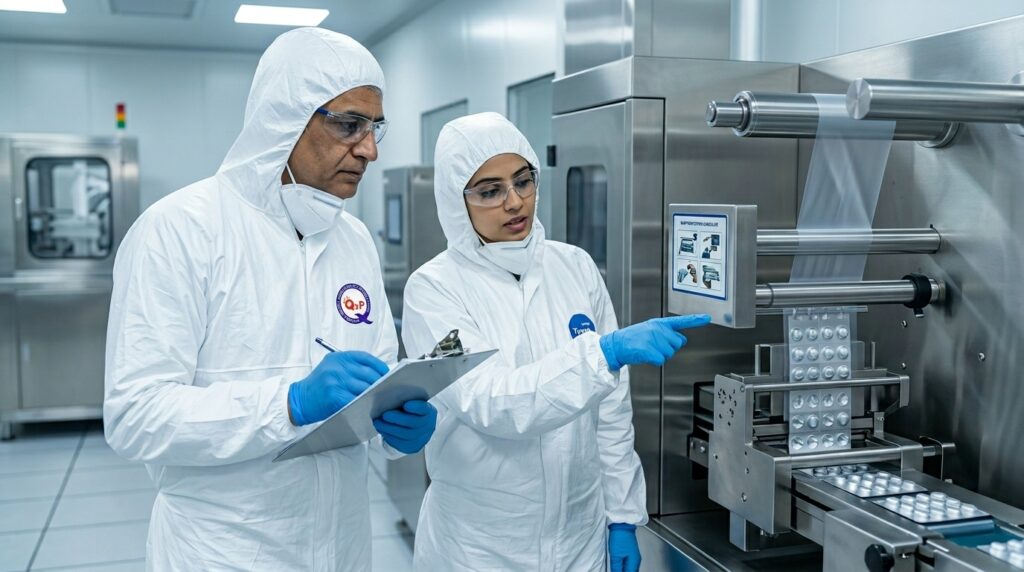
Step-by-Step Process – How We Deliver Equipment qualification services
We believe in a transparent, methodical approach to equipment qualification. Our process is designed to ensure that no critical parameter is overlooked and that your engineering and quality assurance teams are fully aligned throughout the journey.
First, we initiate the Design Qualification (DQ) phase. We cross-verify the vendor’s proposed equipment design against your URS and strict WHO GMP facility layout planning principles. If you are setting up a facility in Bangalore or Chennai, we ensure the design accommodates local climatic conditions, particularly for HVAC and dehumidification equipment.
Next, we move to Installation Qualification (IQ). Our engineers physically verify that the equipment is installed precisely as per the approved design. We check all MOCs, weld logs, calibration certificates, and utility connections. As an experienced clean room design consultant India, we pay special attention to how equipment interfaces with your cleanroom panels to prevent cross-contamination risks.
Following IQ, we execute the Operational Qualification (OQ). This involves testing the equipment across its full operating range, including worst-case scenarios and alarm verifications. If a fluid bed dryer is supposed to shut down at a specific temperature limit, we physically simulate that fault to prove the safety interlocks work.
Finally, we conduct Performance Qualification (PQ). We run the equipment using placebo or actual product to demonstrate that it consistently produces output meeting predetermined quality specifications. For complex project timelines, having a dedicated pharmaceutical project schedule consultant in Gujarat ensures these phases align perfectly with your commercial launch dates.
Real Client Case Study: Multipurpose API Facility in Vadodara
The Challenge: A growing API manufacturer in Vadodara procured five custom glass-lined reactors and a complex solvent recovery system. Their internal team struggled to develop qualification protocols that satisfied their European clients’ audit expectations, leading to a stalled validation master plan.
The Solution: Our team deployed immediately, acting as their dedicated pharma turnkey project consultant. Mr. Vijay Patel led a gap assessment on the vendor-supplied FAT documents. We re-drafted the DQ to clearly map process parameters to the equipment capabilities. We then developed comprehensive IQ and OQ protocols, executing them alongside the client’s operators.
The Result: The entire equipment train was qualified within 45 days. The facility successfully passed a stringent third-party European audit with zero major observations related to equipment qualification. The plant head noted that our practical approach to documenting worst-case operational scenarios was the specific factor that satisfied the auditors.
Our international experience also helps us bring global best practices to domestic projects. You can read about our methodology in complex international environments through our pharma project management consulting in Uzbekistan overview.
If you are looking for a GMP plant design consultant India who can seamlessly integrate equipment validation into your overall facility design, QxP Pharma Project & GMP Services has the practical experience you need. We understand that whether you are in Kolkata or Delhi, your priority is a compliant, efficient, and audit-ready facility.
To help you get started, we offer a Free GMP Gap Assessment Checklist and encourage you to Download our Pharma Plant Setup Cost Guide from our main portal. For immediate assistance, use our WhatsApp CTA to speak directly with our senior engineers. You can always reach us at +91 99798 42207 or +91 99798 94611, or via email at info@qxpts.com.
Frequently Asked Questions
1. What is the difference between FAT and IQ?
- Factory Acceptance Testing (FAT) is conducted at the vendor’s site before shipping to ensure the machine meets basic design criteria. Installation Qualification (IQ) is performed at your facility to verify it has been installed correctly and safely according to the approved design and local utility configurations.
2. How long does it take to qualify a standard packaging line?
- Typically, if all vendor documentation is accurate and utilities are ready, qualifying a standard blister or bottle packaging line takes between 2 to 4 weeks from IQ to OQ completion. PQ timelines depend on product availability.
3. Do you provide qualification services for legacy equipment?
- Yes, we provide retrospective qualification services. We can perform a gap analysis on existing older equipment, re-establish the baseline operational parameters, and draft new protocols to bring legacy machinery up to current Schedule M and CDSCO standards.
4. Is Design Qualification (DQ) mandatory for off-the-shelf equipment?
- While off-the-shelf equipment might not require a complex custom DQ, a formalized design review is still necessary to ensure the standard machine meets your specific User Requirement Specifications (URS) and regulatory needs.
5. Who should approve equipment qualification protocols?
- Protocols must be reviewed by the engineering or production departments and strictly approved by your Quality Assurance (QA) head before any execution begins.
6. Can equipment be used for commercial production after OQ?
- No. Commercial production can only begin after the successful completion and QA approval of the Performance Qualification (PQ) phase, ensuring the equipment works consistently with the actual product.
7. Why is an experienced consultant necessary for equipment validation?
- As an experienced pharma factory layout consultant, a professional ensures that protocols are scientifically sound, risk-based, and capable of withstanding strict regulatory audits, preventing expensive compliance failures and production delays.
