


Subtotal $0.00
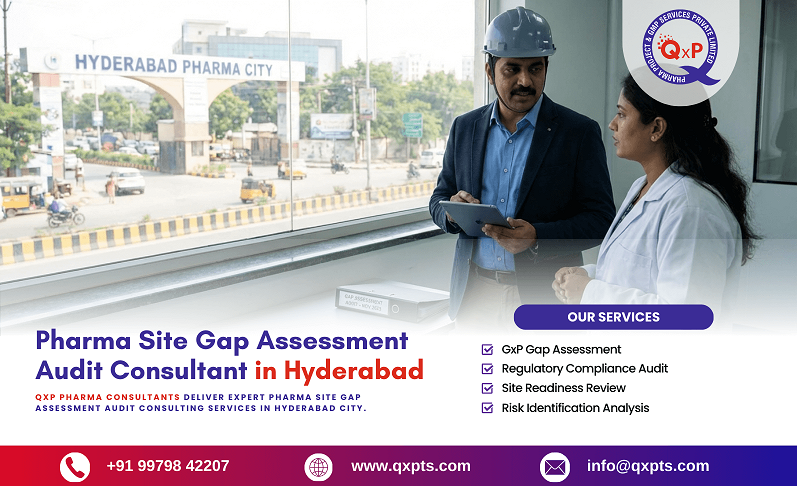
Gap Assessment & GMP Audit for Pharma Sites in Hyderabad: QxP Pharma Consultant
Pharma Site Gap Assessment Audit Consultant in Hyderabad – In today’s highly regulated pharmaceutical and healthcare environment, safety and compliance are no longer limited to internal quality checks. Organizations across India and international markets must address complex requirements related to worker safety, machinery risks, facility standards, environmental controls, and legal accountability. A single oversight can lead to production stoppages, regulatory action, or reputational damage that affects global business relationships.
For companies operating in fast-growing hubs such as Hyderabad — often called India’s pharmaceutical capital — these challenges intensify due to rapid expansion, new facilities, technology upgrades, and international inspections. This is where a Pharma Site Gap Assessment Audit Consultant becomes essential. Such audits identify gaps between current practices and required standards, enabling organisations to take corrective action before regulators, clients, or insurers raise concerns.
Across India, the UAE, Saudi Arabia, Qatar, Oman, the USA, Canada, the UK, Europe, Australia, Southeast Asia, Tajikistan, and Afghanistan, pharmaceutical organisations increasingly rely on structured gap assessments to maintain compliance, protect workers, and sustain global operations.
Growing Importance of Safety & Compliance in Global Industries
Regulatory expectations are tightening worldwide. Governments, multinational clients, and insurance providers now require demonstrable evidence of compliance — not just declarations.
Several factors are driving this shift:
- Increasing industrial accidents are leading to stricter oversight
- Cross-border supply chains requiring standardized safety practices
- Rising legal accountability for executives and facility owners
- Greater scrutiny from international auditors and partners
In international project sites, companies often face overlapping requirements from local authorities, global regulators, and client-specific standards. Pharmaceutical exports to markets such as the USA, Europe, and Australia typically demand compliance far beyond domestic norms.
Consequently, organisations are moving from reactive compliance to proactive gap assessments — identifying risks before they escalate into violations.
What is a Pharma Site Gap Assessment Audit Consultant?
A Pharma Site Gap Assessment Audit Consultant evaluates how closely a facility’s current systems align with required standards — whether regulatory, safety-related, operational, or client-driven.
Unlike routine inspections, gap assessments are forward-looking. They answer critical questions:
- What risks exist today that could trigger future non-compliance?
- Are facilities prepared for international audits?
- Do operational practices match documented procedures?
- Are workers adequately protected and trained?
- Is the infrastructure suitable for current and planned production?
In practical terms, the consultant walks through the entire site — production areas, utilities, warehouses, laboratories, engineering systems, documentation processes, and safety controls — to identify deficiencies.
For organisations expanding globally, this process ensures consistency across locations in India and overseas operations.
Common Safety & Compliance Risks Across Countries
While regulations differ, certain risks are universal across pharmaceutical and healthcare facilities.
- Worker Injuries: Manufacturing plants involve hazardous materials, heavy machinery, pressurised systems, and repetitive operations. Without robust controls, workers face risks of burns, chemical exposure, mechanical injuries, and ergonomic strain.
- Machinery & Project Hazards: New equipment installation, plant modifications, or capacity expansion projects introduce additional risks. Improper integration can compromise both safety and product quality.
- Reputation Damage: In global markets, safety incidents quickly impact trust. Hospitals, regulators, and distributors prefer suppliers with demonstrable safety culture.
How Professional Safety Certification Reduces Risk?
A structured gap assessment does more than identify problems — it provides a roadmap for improvement.
Key elements include:
- On-Site Inspections: Physical verification of facilities, equipment, utilities, safety systems, and workflows.
- Documentation Review: Evaluation of policies, procedures, training records, maintenance logs, and incident reports.
- Alignment with Global Best Practices: Recommendations based on internationally accepted standards while respecting local legal requirements.
In many cases, organisations discover that their internal procedures exist but are inconsistently implemented. Bridging this gap significantly reduces risk exposure.
Country-Specific Compliance Considerations
Operating across multiple regions requires understanding local expectations alongside global norms.
- India: Indian pharmaceutical facilities must consider labour safety obligations, factory regulations, environmental requirements, and occupational health expectations. Rapid industrial growth often means legacy infrastructure coexists with modern systems, creating compliance gaps.
- Middle East (UAE, Saudi Arabia, Qatar, Oman): Construction-heavy projects and multinational workforces demand strict contractor safety management, site access control, and emergency preparedness. Authorities emphasise visible compliance and documented procedures.
- USA, UK, and Europe: Facilities in these regions face rigorous audits, detailed documentation requirements, and strong enforcement mechanisms. Even minor deviations can trigger major corrective actions.
Gap assessments help organisations exporting to these markets ensure readiness before inspections occur.
Worker Training & On-Site Safety Implementation
Policies alone do not protect workers — practical implementation does.
Global facilities often employ diverse teams speaking different languages and coming from varied safety cultures. Effective programs must therefore include:
- Multilingual training materials
- Visual safety instructions
- Hands-on demonstrations
- Regular refresher sessions
- Supervisor accountability
In international environments, cultural factors influence how workers perceive risk and authority. Consultants design training approaches that respect these differences while maintaining high standards.
Machinery, Equipment & Project Safety (Global Perspective)
Pharmaceutical facilities involve complex systems that must operate safely and reliably.
- Manufacturing Operations: Production lines must control mechanical hazards, chemical exposure, contamination risks, and process deviations.
- Construction & Plant Modifications: Expansion projects introduce temporary risks — scaffolding, electrical work, confined spaces, heavy lifting, and contractor coordination.
- Hospitals & Critical Facilities: Healthcare environments require additional safeguards because failures can directly impact patient care. Backup systems, infection control measures, and emergency preparedness are essential.
A comprehensive gap assessment evaluates all these aspects together rather than in isolation.
Role of Safety Audits, Reporting & Documentation
Documentation is the backbone of compliance. Regulators and clients rely on records to verify that systems function as intended.
Key components include:
- Incident reporting and investigation systems
- Maintenance records
- Training logs
- Safety inspection reports
- Emergency preparedness plans
- Risk assessments
Organisations lacking structured documentation often struggle during audits, even if actual practices are reasonably safe.
Insurance providers also assess documentation before underwriting industrial policies. Demonstrated risk management can influence coverage terms and premiums.
Long-Term Business Value of Global Safety Certification
Investing in gap assessments and safety improvements yields measurable business benefits.
- Fewer Accidents: Reduced injuries lower medical costs, compensation claims, and productivity losses.
- Stable Operations: Facilities with robust safety systems experience fewer disruptions and shutdowns.
- International Credibility: Global clients prefer suppliers who can demonstrate consistent compliance across locations.
- Employee Confidence: Workers are more productive when they trust that their workplace is safe.
In international project sites, companies with strong safety records often secure contracts more easily than competitors with uncertain compliance history.
What to Check Before Choosing a Safety Certification Partner?
Not all consultants offer the same level of expertise. Organisations should evaluate potential partners carefully.
Consider the following:
- Experience across the pharmaceutical and healthcare sectors
- Familiarity with both Indian and international regulations
- Ability to conduct practical on-site assessments
- Capability to provide actionable recommendations
- Transparent reporting methodology
- Availability for follow-up support
A gap assessment should produce clear, prioritised actions — not just theoretical observations.
Why Working with a Globally Oriented Safety Firm Matters?
Companies operating across borders require consistency without ignoring local realities.
A globally oriented safety partner provides:
- Standardised assessment frameworks adaptable to different countries
- Understanding of diverse regulatory expectations
- Experience with multinational audits
- Ability to coordinate across multiple sites
- Ongoing advisory support
Organisations such as QXP Pharma Project Consultant & GMP Service PVT LTD work with clients in India and international markets to bridge these gaps through structured, practical assessments. Their approach emphasises real-world implementation rather than theoretical compliance.
For organisations planning expansion, modernisation, or regulatory submissions, such support can significantly reduce uncertainty.
Conclusion:
Safety and compliance are not optional administrative tasks — they are fundamental responsibilities toward workers, patients, clients, and society. In the pharmaceutical and healthcare industries, where risks can affect public health, the stakes are especially high.
A Pharma Site Gap Assessment Audit Consultant in Hyderabad helps organisations identify vulnerabilities before they become crises. By addressing gaps proactively, companies can protect their workforce, maintain operational continuity, and strengthen their reputation in global markets.
For leaders managing facilities across India, the Middle East, Europe, North America, and beyond, investing in professional gap assessments is a practical step toward sustainable growth.
Organisations seeking structured guidance can explore professional support from experienced firms such as QXP Pharma Project Consultant & GMP Service PVT LTD via their official website: 👉https://www.qxpts.com/
A proactive approach today can prevent costly disruptions tomorrow.
Key Takeaways
- Worker safety is a legal, ethical, and operational priority worldwide
- Gap assessments identify risks before regulators or incidents expose them
- Compliance requirements vary across countries but share common principles
- Training and documentation are critical for effective implementation
- Strong safety systems enhance credibility with global clients
- Choosing an experienced, internationally aware partner is essential
- Proactive compliance supports long-term business stability
Frequently Asked Questions (F&Q)
Q1. Why is a Pharma Site Gap Assessment important before regulatory audits?
- It identifies deficiencies in facilities, procedures, and documentation, allowing corrective actions before inspectors arrive.
Q2. How often should pharmaceutical facilities conduct gap assessments?
- Typically, before major expansions, regulatory inspections, certification renewals, or entry into new markets.
Q3. Can gap assessments help hospitals as well as manufacturing plants?
- Yes. Hospitals face similar safety, infrastructure, and compliance challenges, particularly regarding patient safety and emergency preparedness.
Q4. Do international clients require formal safety audits?
- Many global buyers and partners expect documented evidence of safety and compliance systems before entering contracts.
Q5. What makes Hyderabad a critical location for such audits?
- As a major pharmaceutical hub, facilities in Hyderabad frequently interact with international regulators and clients, increasing compliance expectations.
#PharmaCompliance #SafetyAudit #GapAssessment #PharmaConsultant #GMPCompliance #IndustrialSafety #GlobalCompliance #HyderabadPharma #HealthcareSafety #RiskManagement #AuditReadiness #PharmaIndustry #WorkplaceSafety #RegulatoryCompliance #QXPPharma
